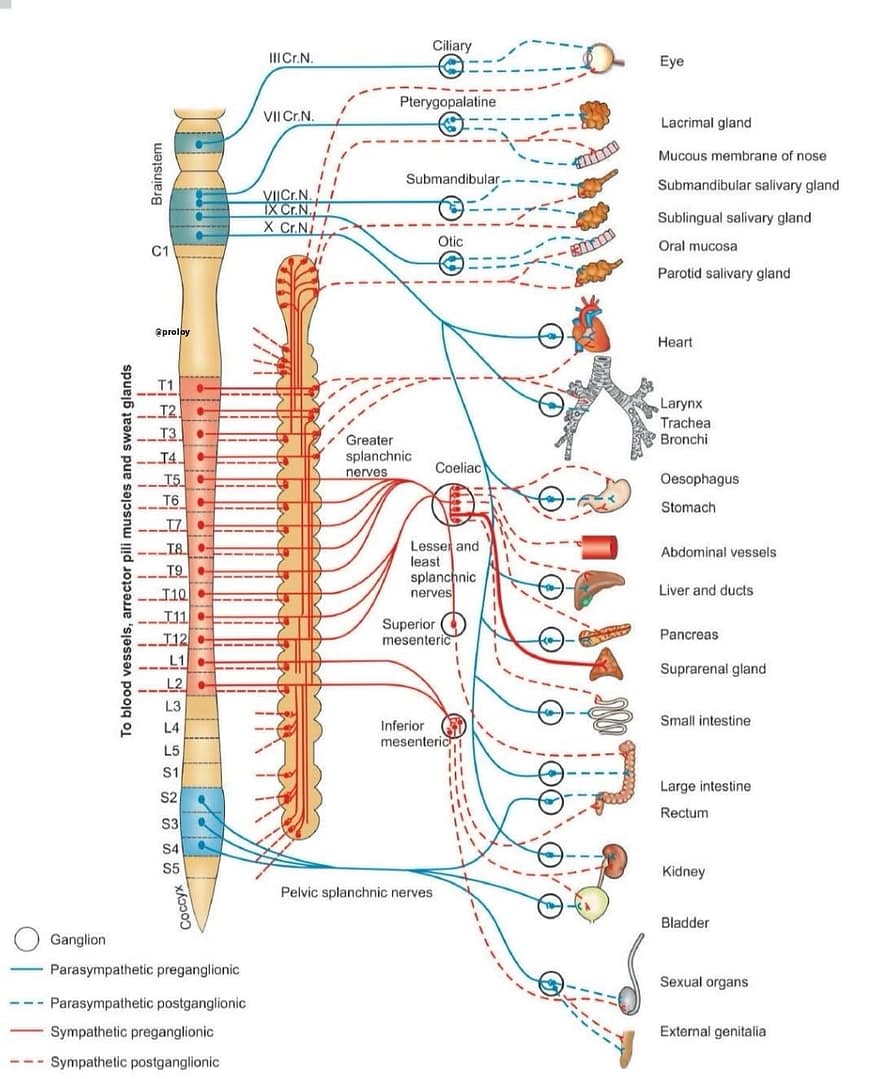
Your heart beats. Your pupils adjust to light. Your stomach digests food. All of this happens without you thinking about it. Welcome to the world of the autonomic nervous system—your body’s automatic pilot.
What Is the Autonomic Nervous System?
The autonomic nervous system, or ANS, is the part of your nervous system that controls everything you don’t have to think about. While you’re focused on reading this, your ANS is busy regulating your heart rate, adjusting your blood pressure, managing your breathing, and orchestrating digestion.
Think of it as your body’s background operating system, constantly running programs you never have to manually start.
The ANS has two primary branches that work in beautiful opposition: the sympathetic nervous system and the parasympathetic nervous system. Together, they maintain balance—what scientists call homeostasis.
The Sympathetic Nervous System: Your Inner Alarm System
Imagine you’re walking alone at night and hear footsteps behind you. Your heart races. Your breathing quickens. Your pupils dilate. You’re suddenly alert and ready to run. That’s your sympathetic nervous system at work.
This system originates from the thoracolumbar region of your spinal cord, specifically segments T1 through L2. When activated, it prepares your entire body for action.
What Happens During Sympathetic Activation?
Your body undergoes remarkable changes within seconds. Your heart pumps harder and faster, delivering oxygen-rich blood where it’s needed most. Your airways expand, allowing you to take in more oxygen. Blood vessels constrict in your skin and digestive organs but dilate in your muscles—essentially redirecting resources to where they matter most in a crisis.
Your pupils widen to take in more visual information. Digestion slows down because, frankly, breaking down that sandwich isn’t a priority when you’re facing danger. You start sweating to prevent overheating. Your adrenal glands release adrenaline and noradrenaline, amplifying all these effects.
Even your bladder gets the message. Its wall relaxes while the sphincter contracts, preventing an untimely bathroom break during your escape.
This is why the sympathetic system is often called the “fight or flight” response. It’s your survival mode.
The Parasympathetic Nervous System: Your Reset Button
Now imagine you’re home after that stressful walk, safely on your couch with a warm cup of tea. Your breathing slows. Your heart rate drops. You feel your body unwinding. That’s your parasympathetic nervous system taking over.
This system has a different origin point—the craniosacral region, which includes specific cranial nerves from the brainstem and sacral segments S2 through S4 of your spinal cord.
What Happens During Parasympathetic Dominance?
Everything the sympathetic system ramped up, the parasympathetic system dials back down. Your heart rate decreases, conserving energy. Your airways return to normal size. Blood flow shifts back to your digestive organs, and digestion kicks into high gear—this is prime time for your body to extract nutrients from food.
Your pupils constrict, protecting your retinas and helping with near vision. Various glands activate, producing saliva, tears, and digestive enzymes. Your bladder’s wall contracts while the sphincter relaxes, making it easy to urinate when appropriate.
This is your “rest and digest” mode—the state where healing, growth, and recovery happen.
The Dance of Balance
These two systems aren’t enemies. They’re dance partners, each taking the lead at different times to keep you healthy and responsive.
When you exercise, your sympathetic system dominates, pushing your cardiovascular system to deliver oxygen to working muscles. When you finish and cool down, your parasympathetic system gradually takes over, bringing your body back to baseline.
When you eat a meal, your parasympathetic system enhances digestion. But if you suddenly need to move—say, you smell smoke—your sympathetic system can instantly override that, redirecting energy away from digestion and toward escape.
This constant back-and-forth is how your body maintains equilibrium.
The Chemistry Behind the Control
Both systems use chemical messengers called neurotransmitters to communicate with organs and tissues.
The sympathetic system primarily uses acetylcholine for its initial signals, then switches to norepinephrine (and sometimes epinephrine) for the final message to target organs. These chemicals bind to adrenergic receptors, triggering the characteristic fight-or-flight responses.
The parasympathetic system uses acetylcholine throughout its entire pathway, binding to muscarinic receptors that produce the calming, restorative effects.
When Things Go Wrong
Understanding the ANS becomes especially important when it malfunctions.
Chronic stress can leave your sympathetic system in overdrive, contributing to anxiety, high blood pressure, and cardiovascular problems. It’s like keeping your car’s engine revving in the red zone all the time—eventually, something’s going to break.
Conversely, excessive parasympathetic activity can cause problems too. Vasovagal syncope—when you faint at the sight of blood or during extreme stress—happens when your parasympathetic system suddenly overcorrects, dropping your heart rate and blood pressure too quickly.
Diseases like diabetes can damage both systems, a condition called autonomic neuropathy. This can affect heart rate regulation, digestion, blood pressure stability, and more.
Why This Matters
Understanding your autonomic nervous system gives you insight into your body’s automatic responses. That racing heart before a presentation? Sympathetic activation. The drowsy feeling after a large meal? Parasympathetic dominance. The way your body responds to chronic stress? Your ANS struggling to maintain balance.
This knowledge empowers you to work with your body rather than against it. Stress management techniques, regular exercise, good sleep habits, and mindful breathing all support healthy ANS function.
Your autonomic nervous system is always working, always balancing, always adapting. It’s been keeping you alive since before you were born, and it will continue until your last breath—all without you having to ask.