Published on the Day of the Medicine Buddha, commemorated on the 8th day of every lunar month.
There is a figure in the Buddhist tradition whose very presence, according to ancient texts, can activate the healing processes already living within us. Not as external magic, but as a mirror reflecting our own innate capacity to heal.
His name is Bhaishayiaguru — the Medicine Buddha — known in Tibetan as Sangye Menla. His practice has been central to Buddhist traditions across Asia for centuries, and his relevance, remarkably, only seems to grow.
Who Is the Medicine Buddha?
His full Sanskrit name is Bhaiṣajyaguru Vaiḍūrya Prabha, which translates as Master of Medicine of Lapis Lazuli Light. Every part of the name is a key: bhaishayia means medicine, guru means teacher, vaidurya refers to lapis lazuli — a gemstone of almost inaccessible origin — and prabha means light or radiance.
He is the patron of the Four Medical Tantras, the foundation of Tibetan medicine, and his figure stands at the center of healing practices that encompass the physical body, the mind, and the spirit.
His pure realm is called Shudarsana — “Beautiful to Behold” in Sanskrit — a land situated in the east where the ground is made of lapis lazuli and the roads are lined with gold. Those who are reborn there, tradition holds, become true healers.
The Lapis Lazuli Blue: Why His Color Means Everything
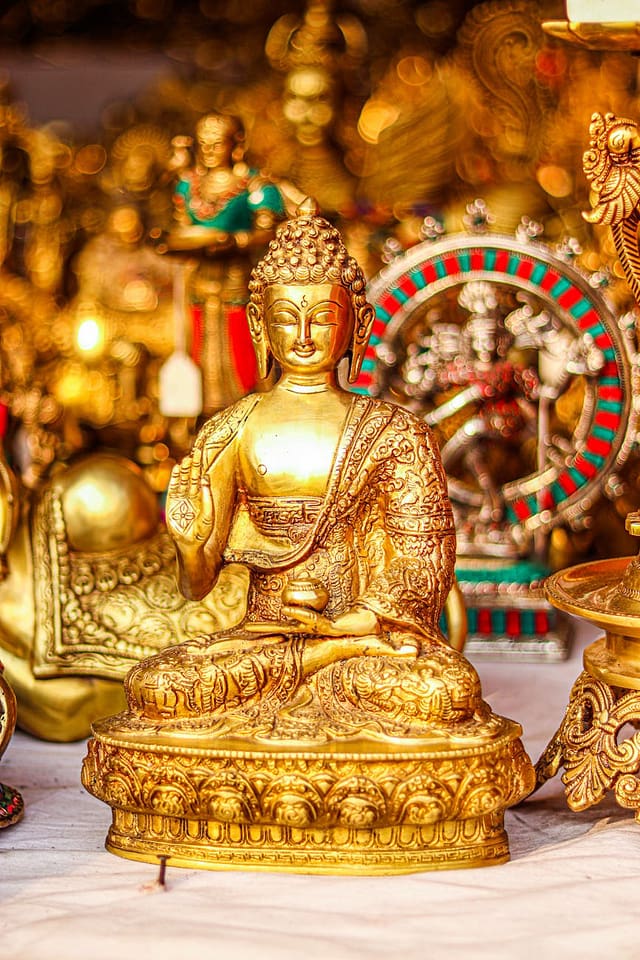
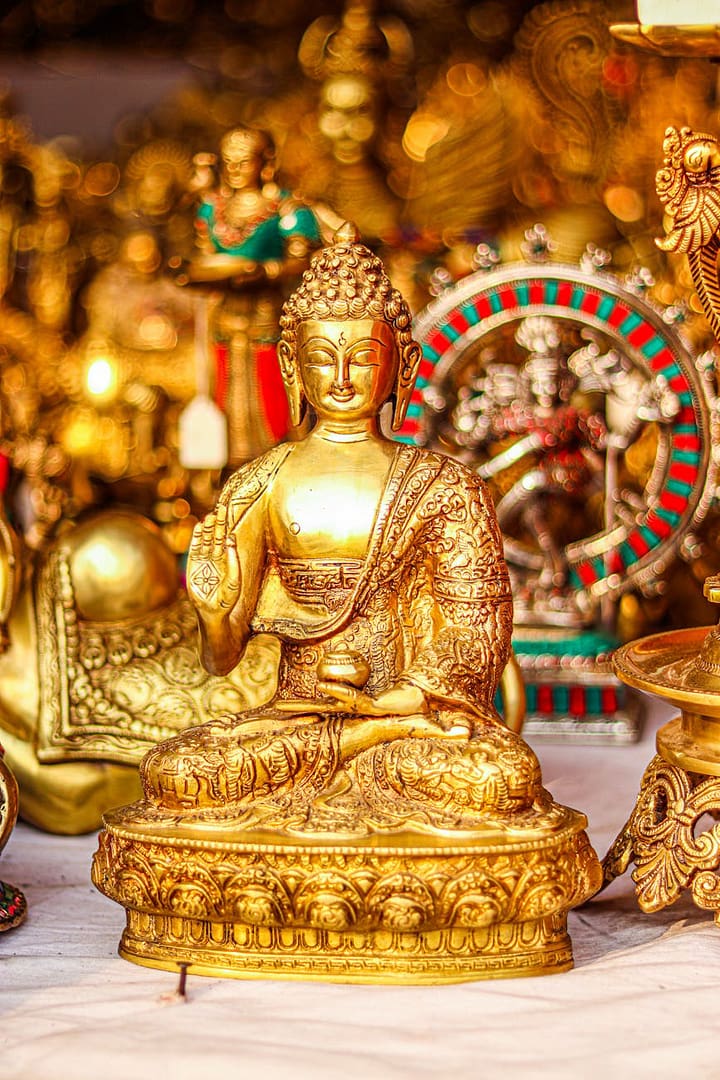
Unlike the Buddha Shakyamuni, whose skin is depicted in gold, the Medicine Buddha is always shown in a deep, vivid lapis lazuli blue. This is not decorative — in Buddhism, that color represents the unchanging, the pure, the beyond-concept.
Lapis lazuli was considered an almost divine material: extracted from remote mountains (primarily in what is now Afghanistan), so difficult to obtain that spirits were said to help humans retrieve it. Its association with healing power makes it the perfect symbol for this deity.
His hands, too, speak their own language:
- The left hand rests in meditation and holds a bowl filled with healing nectar, symbolizing the power to eliminate illness at its very root.
- The right hand, extended in a gesture of supreme giving, holds a sprig of myrobalan (arura), a Tibetan medicinal plant whose properties heal both body and mind.
His 12 Aspirations: A Compassion That Leaves No One Behind
What makes Bhaishayiaguru singular are the twelve vows he made while still a bodhisattva — commitments spoken before reaching full buddhahood. Each one begins with the same solemn promise: “In the future, when I have attained awakening…”
These vows are anything but abstract. They address very real dimensions of human suffering:
To illuminate darkness — that his light reach even those lost in the deepest shadows, physical or mental.
To satisfy lack — that no being, in any realm, goes without what they need. An aspiration that touches one of the most universal wounds: the feeling that there is never enough.
To guide toward awakening — to lead all beings, wherever they are starting from, toward the path that leads to genuine happiness.
To heal the body — to restore the physical faculties of those born with limitations or who have lost their health. Even when transformation isn’t immediate, the practice opens doors of karmic healing that may unfold gradually.
To free the oppressed — to protect those who are persecuted, imprisoned, tortured, or threatened. His compassion makes no distinction between spiritual suffering and political suffering.
To nourish the hungry — to first feed the body, and then offer the Dharma as spiritual nourishment.
To remove all barriers — in the context of ancient India, one vow spoke of freeing women from the restrictions that blocked their full spiritual development. Today it is understood as a commitment to dismantle any barrier — of gender, origin, or class — that prevents access to practice and awakening.
Taken together, these twelve vows form a vision that resonates with some of the deepest values of our time: dignity, equity, liberation from suffering in all its forms.
What Does the Practice of the Medicine Buddha Actually Transform?
Traditional Buddhist texts describe a broad spectrum of benefits, ranging from the everyday to the profoundly spiritual.
The practice works on negative mental states — greed, jealousy, and competitiveness — softening them from within. It offers protection against physical and spiritual harm. And at a deeper level, it gradually purifies the veils that cloud the mind, freeing its innate resilience.
One point is especially striking for the modern world: this practice is directly linked to healing addiction. When the Buddha Shakyamuni taught the Four Noble Truths, he pointed to tanha — craving, insatiable desire — as the root of suffering. Today we might call it addiction: that persistent dissatisfaction that drives us toward toxic patterns, whether with substances, relationships, overwork, or anything else we use to fill a void that never quite fills.
The Medicine Buddha points directly at that root.
A Healer for Our Time
What is remarkable about this figure is not just his antiquity, but his relevance. His aspirations cover exactly what we most need today: integral healing, equity, protection of the vulnerable, freedom from addiction and scarcity, and a path toward a life with genuine meaning.
According to tradition, you don’t need to be a Buddhist practitioner to receive his benefit. Simply hearing his name, contemplating his image, or reciting his mantra may be enough to awaken something within.
Ancient wisdom, sometimes, is the most contemporary thing there is.
Had you heard of the Medicine Buddha before? Is there one of his twelve vows that resonates with you personally?
Primary source: Article by Cecilia Pedot at Paramita.org — drawing on Buddhist sutras and reference works including The Healing Buddha by Raoul Birnbaum and translations from 84000.co.