There’s a pervasive myth in the sound healing community that what we do is rooted in ancient tradition. You’ll hear it everywhere: “the ancients used these bowls for healing,” “this is a 5,000-year-old practice,” “we’re reviving lost wisdom.” But here’s the truth that might surprise you: modern sound baths are exactly that—modern. And that’s not just okay, it’s actually exciting.
The “Ancient” Myth: Why We Cling to It
Before we dive deeper, let’s acknowledge why the ancient narrative is so appealing. In a world that often dismisses alternative wellness practices, wrapping our work in the legitimacy of “timeless tradition” feels protective. If something has been done for thousands of years, surely it must be valid, right?
But this impulse—however understandable—does us a disservice. It’s remarkably similar to the practitioners who layer pseudo-science onto sound work, trying to validate something that’s already valuable. The truth is simpler and more empowering: sound baths work because they work. The proof is in the profound responses we witness daily, not in manufactured lineages.
Let’s Talk About Our Tools
Consider the instruments that define contemporary sound work:
Crystal singing bowls—arguably the cornerstone of modern sound baths—have existed for approximately 50 years. Not 500. Not 5,000. Fifty. They’re a product of modern technology, impossible to create in ancient times.
Himalayan or Tibetan metal bowls were originally utilitarian objects designed for food, not sound. We’ve repurposed them beautifully into singing bowls, but this is a contemporary innovation. As Frank Perry, one of the most knowledgeable practitioners and historians of bowls, states plainly: “singing bowls are not, and were never intended to be, musical instruments.”
Koshi chimes were created in 2009—less than two decades ago.
Ocean drums emerged in 1972.
Gongs have ancient roots, yes, but not in the way we use them. Historically, they served military signaling and ceremonial functions—think trumpet blasts, not 60-minute sonic journeys. There were no collections of artisan mallets, no flumies, no immersive sound experiences designed to guide meditation or facilitate healing in the way we practice today. While tuned metal discs appear in traditional gamelans, that musical context is vastly different from our modern gong work.
Handpans are entirely 21st-century instruments, though they descend from steel drums. Even so, they represent a significant evolution in both sound and application.
Monochords as we know them—strumming multiple strings tuned to the same note—are a modern iteration, despite the instrument’s ancient name.
Glass pyramids were invented within this century.
Even our tuning standards—A440 and the popular A432—are modern constructs. Accurate frequency measurement in Hertz only became possible around 1930, less than 100 years ago. Before that, there were no precise tuners, which means claims about “ancient healing frequencies” are, at best, speculative.
The Thought Experiment
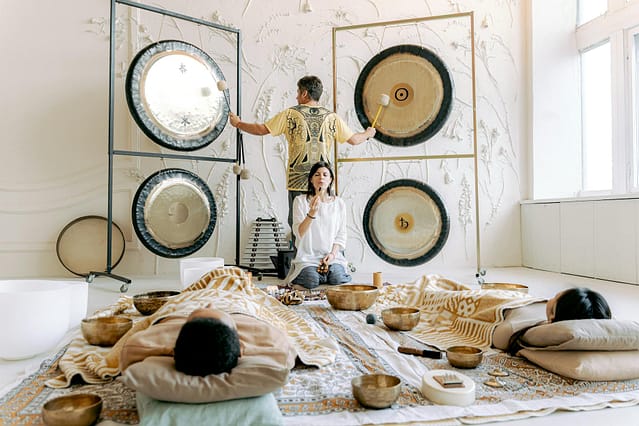
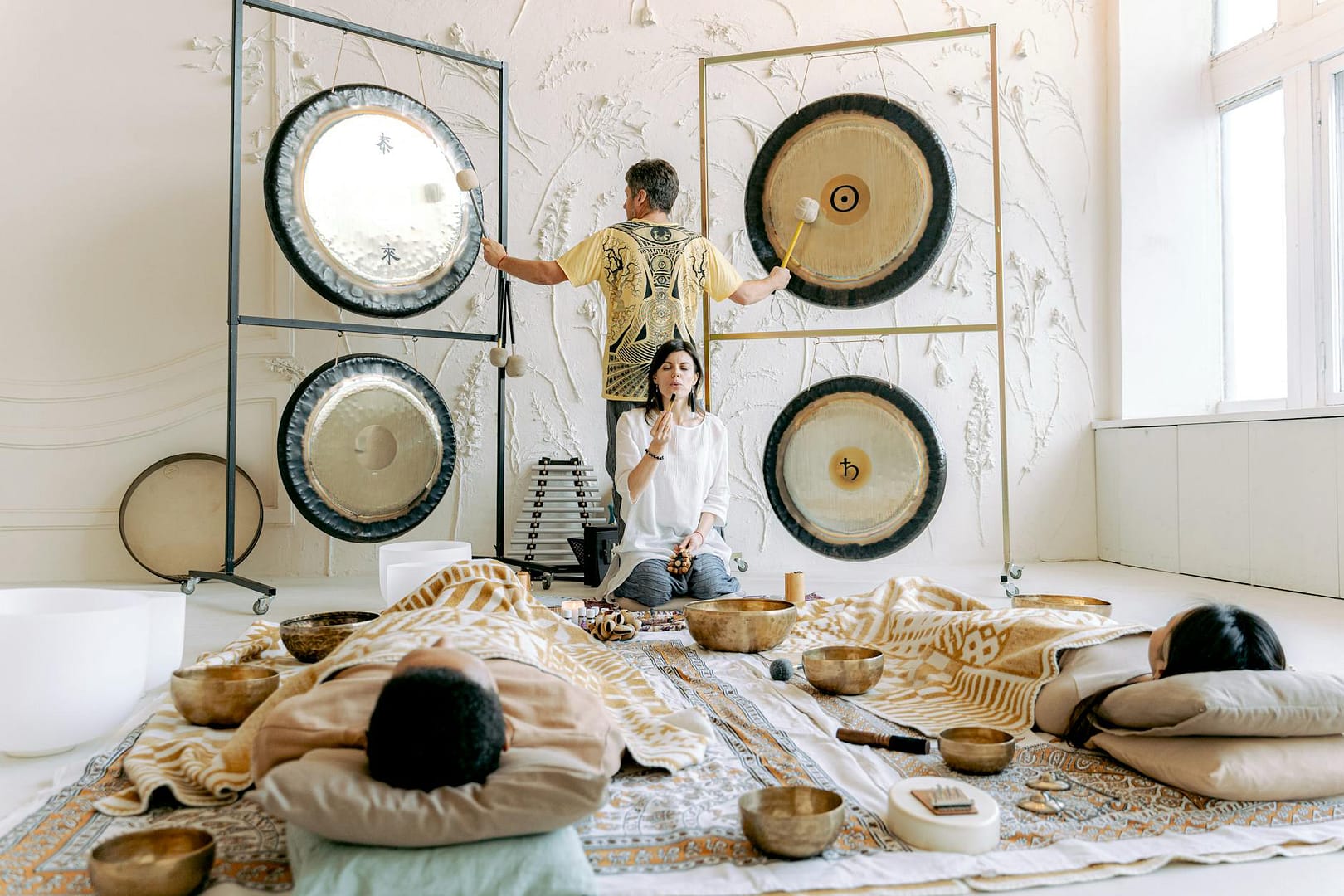
Imagine this: you take a contemporary sound bath practitioner with their full setup—crystal bowls, multiple gongs, Koshi chimes, ocean drum, singing bowls, and handpan—and drop them into an ancient Tibetan monastery or an indigenous ceremony.
The reaction would likely be bewilderment, possibly offense: “Why are you rubbing that gong with a ball? Why are you banging on our food dishes? This is not music! This is not how we use these objects!”
This isn’t to diminish ancient wisdom or traditional practices—both deserve deep respect. But it illustrates a crucial point: what we do is fundamentally new.
Why Now? Why This Explosion?
If sound baths are so new, why have they spread with such remarkable speed over the past couple of decades? Why are people flocking to sound experiences in unprecedented numbers?
The answer likely lies in our contemporary moment. We live in an age of:
- Overwhelming sensory bombardment
- Constant digital connectivity
- Unending demands on our attention
- Chronically activated nervous systems
- Diminished access to genuine rest
Sound baths offer something our ancestors didn’t need in quite the same way: a profound respite from nervous system overwhelm. We’ve collectively created a new modality that responds to a modern condition.
A handful of pioneering sound explorers began this work in the last century, but the current explosion tells us something important: this practice meets a genuine need. People respond because it works, not because it’s ancient.
The Power of Being Present to Creation
There was a time when someone (or many someones) invented, discovered, developed, or perhaps downloaded:
- Acupuncture
- Kirtan
- String quartets
- Reiki
- Jazz
- Breathwork
- Symphonies
- Shiatsu
- Opera
Each of these modalities had a genesis point. Each was once startlingly new. And the people involved in those early days were doing something both thrilling and daunting: creating something that hadn’t existed before.
That’s exactly where we are with sound work.
Our Opportunity and Our Responsibility
Understanding that we’re pioneers rather than preservationists changes everything. It means:
We have creative freedom. We’re not bound by ancient protocols we must faithfully reproduce. We can experiment, innovate, and evolve our practice based on what actually serves our clients.
We have responsibility. As co-creators of this modality, how we practice, teach, and represent this work shapes its future. Our integrity matters—including our honesty about what sound work is and isn’t.
We get to write the story. Rather than claiming false lineages, we can tell the true story: that a growing community of practitioners, responding to genuine need, has collectively birthed a new healing modality that’s spreading because of its efficacy.
We can stay humble. Acknowledging that our practice is young means remaining open to learning, refining, and discovering. We’re still figuring this out, and that’s beautiful.
Nothing Needs to Be Ancient to Be Valuable
Many ancient ideas haven’t stood the test of time. The sun doesn’t revolve around the Earth. Bloodletting doesn’t cure disease. Antiquity alone doesn’t confer truth or value.
Conversely, something brand new can be profoundly meaningful and effective from its inception. Penicillin didn’t need to be ancient to save millions of lives. Therapy techniques like EMDR work despite being only decades old.
Sound baths are valuable because they work, because they meet people where they are, because they offer something genuine. That’s enough. That’s everything.
An Invitation to Ownership
So here’s my invitation to fellow sound workers:
Let’s stop borrowing false authority from imagined traditions. Let’s own what we actually are—pioneers of a emerging modality. Let’s embrace the responsibility and excitement of that role.
Let’s be honest with our clients about what we’re offering: not ancient wisdom repackaged, but a contemporary practice that’s proven remarkably effective at helping people find respite, regulation, and renewal in our overwhelming modern world.
Let’s honor actual ancient traditions by not appropriating them or misrepresenting their practices. And let’s honor our own work by acknowledging its true nature and power.
We are the co-creators of sound work, right here, right now. This is both our opportunity and our responsibility.
And honestly? That’s far more exciting than any invented ancient lineage could ever be.
This is my perspective, formed through practice and observation. As I’ve learned, I could always be wrong—and I welcome the ongoing conversation that helps us all understand this work more deeply.